
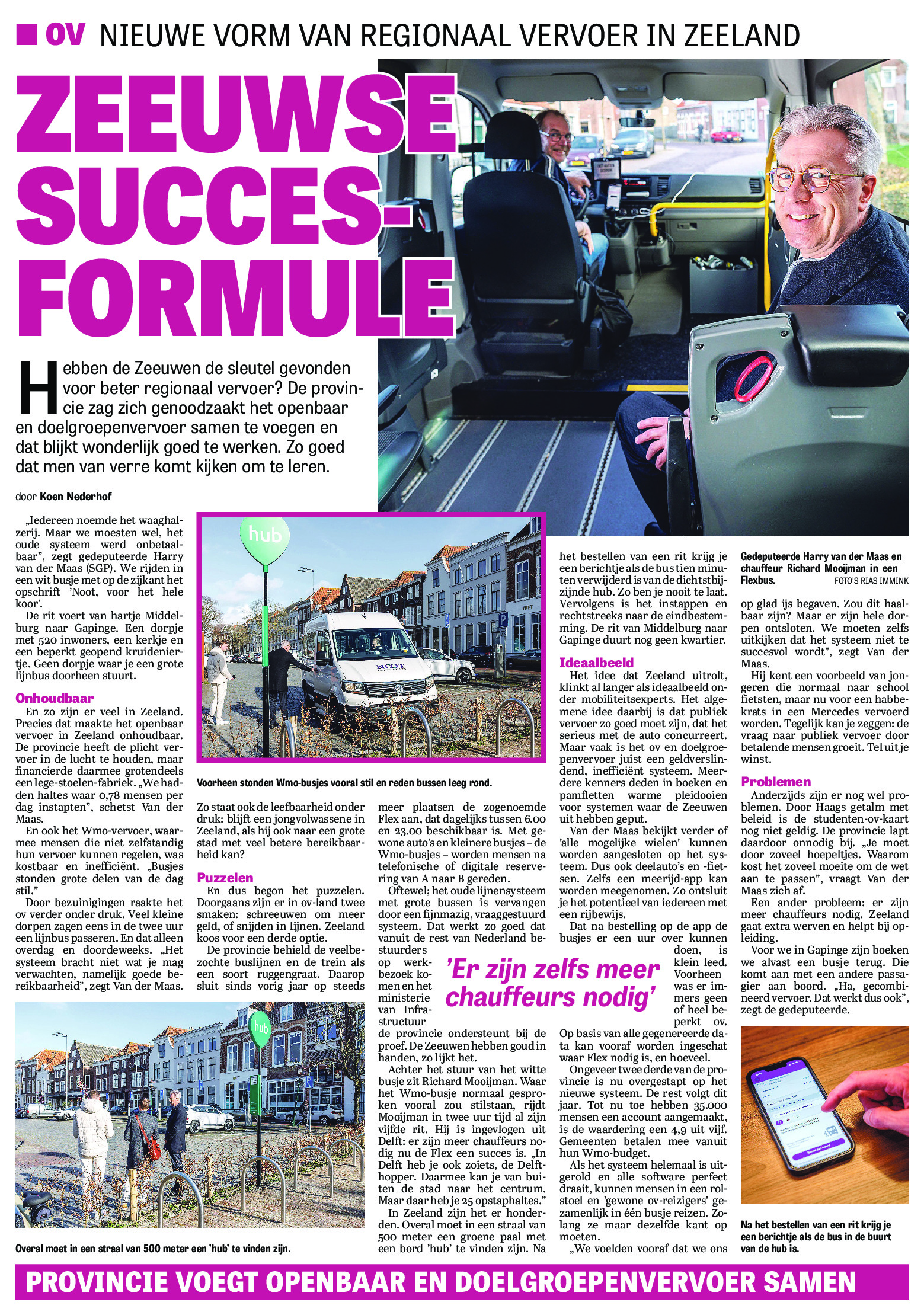
 Recent coverage in one of the Netherlands’ largest newspapers highlights the first real-world results of a new demand-driven public mobility system in Zeeland.
The system shows that public mobility can move beyond traditional models: offering more options, better accessibility, and a closer fit to how people actually travel — including evenings, rural areas and first/last mile connections.
Over the past two years, I have been closely involved as an architect and designer of this system, working with the province, municipalities and the Ministry of Infrastructure and Water Management.
What stands out is that the discussion often avoids a fundamental question:
how effectively are public funds translated into real accessibility for citizens?
The Zeeland case demonstrates that it is possible to achieve both:
improved accessibility for users
and more efficient use of public resources
Rather than subsidising underused capacity, this approach focuses on demand-driven, near door-to-door mobility — reducing dependency on private car ownership.
These insights are brought together in the new book Smart Mobility, based on four years of research, real-world implementation and analysis across multiple Dutch regions.
The conclusion is clear: this model is not only viable, but scalable — and opens the door for both public and private investment in future mobility systems.